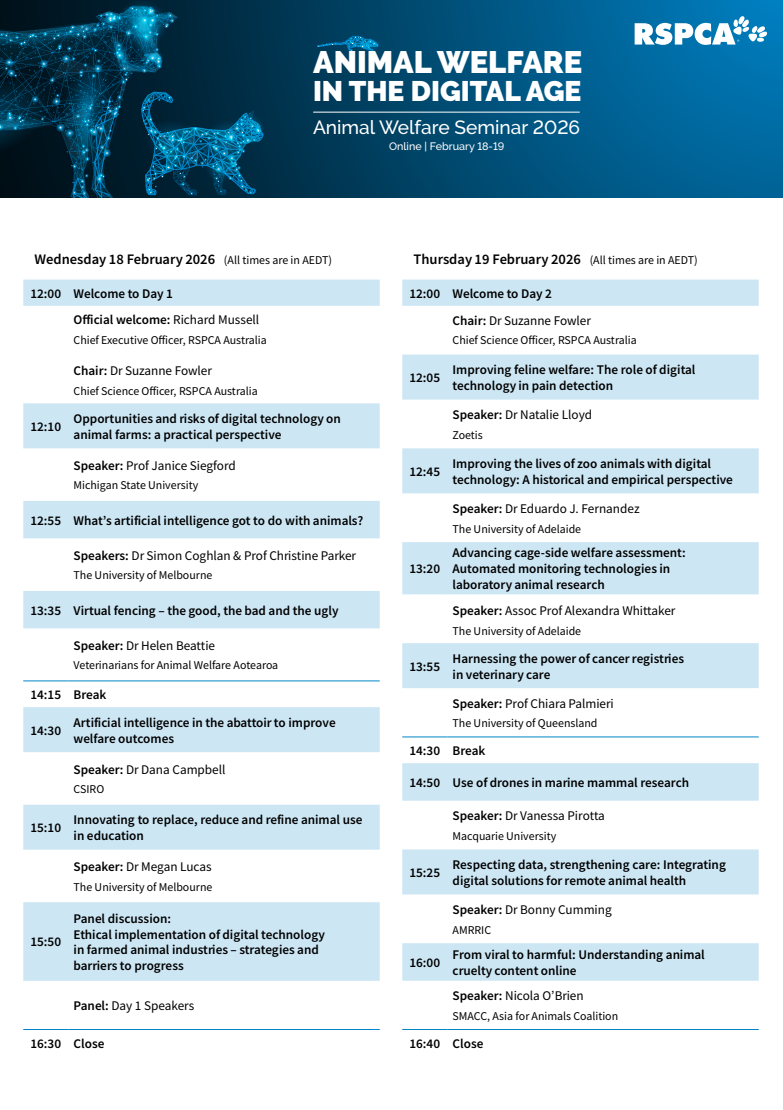
Click the thumbnail below to download the Seminar program (PDF 390KB)
[](https://hub.rspca.org.au/attachments/68) # Speaker biosClick the thumbnail below to download the speaker bios (PDF 2.1MB)
[](https://hub.rspca.org.au/attachments/69) # Presentation abstracts # Abstract - Beattie #### Virtual fencing – the good, the bad and the ugly In 2024, VAWA commenced the development of a Code of Ethical Practice for Virtual Fencing Technology (VFT). This followed engagement with the industry and alignment in concerns about the lack of animal welfare regulation for VFT use in New Zealand, and other jurisdictions. While VFT poses some potential benefits from an animal and environmental health perspective, there are also costs to both. Some aspects of VFT development and use are well regulated and transparent, such as the safety of electrical devices. Other aspects are highly variable and concealed, for example, the amount of electricity used on animals, the animal welfare expertise in development teams, and the use of devices for herding and drafting. There is also uncertainty on whether independent research sufficiently supports VFT deployment to alternate applications (e.g., dairy to beef), and how strong the evidence is for other statements commonly made about its benefits e.g., environmental claims. As VFT is adopted more widely, ideally, manufacturers would abide by the voluntary Code of Ethical Practice, to ensure that animals are treated consistently by both established and emerging VFT products to the market, and farmers are clear about robustness of welfare and other claims. **Dr Helen Beattie** Veterinarians for Animal Welfare Aotearoa (VAWA) # Abstract - Campbell #### Artificial intelligence in the abattoir to improve welfare outcomes Lairage time for beef cattle is the period following transportation to the abattoir where the animals are confined in pens before being taken to slaughter. Optimising the environment during this period may better meet animal welfare requirements as well as reducing risks to meat quality. The lairage duration is a short and critical time period with high animal throughput. Supportive animal monitoring tools can improve the ability to continuously monitor animals for implementing housing change or timely interventions as needed. A system applying computer vision algorithms was developed to automatically classify cattle behaviours of lying, standing, and walking in lairage pens at a commercial abattoir. Real-time analysis of cattle behaviour was able to detect differences in behaviour based on flooring substrate. This is one example of how the application of computer vision monitoring can be a tool to inform on housing and management change that can improve animal welfare in this context. This presentation will discuss the development and application of artificial intelligence in abattoirs and how these types of systems can aid in optimising animal welfare and meeting regulatory auditing requirements. **Dr Dana Campbell** Senior Research Scientist CSIRO (Commonwealth Scientific and Industrial Research Organisation) # Abstract - Coghlan & Parker #### What’s artificial intelligence got to do with animals? Artificial intelligence (AI) is reshaping human societies — but what might it mean for animals? This presentation explores how emerging AI technologies could impact on nonhuman lives, for better and for worse. After a brief introduction to the nature of modern AI systems, we will examine their implications across key domains: - Animal agriculture and intensive farming - Veterinary medicine and animal healthcare - Decoding animal communication - Generative AI in text, images, and video - Social media recommenders and their ripple effects - Citizen science initiatives - Conservation and wildlife management The presentation will also consider ethical and legal frameworks, codes, and guardrails for AI and ask how animals might be included within them. Attendees will gain an overview of how this powerful technology could affect not only human lives but also the lives of other sentient beings. **Dr Simon Coghlan** Senior Lecturer in the School of Computing and Information Systems (CIS) University of Melbourne **Prof Christine Parker** Professor of Law University of Melbourne # Abstract - Cumming #### Technology opportunities for animal health management in remote communities Access to veterinary care in remote communities has long been constrained by distance, limited infrastructure, and systemic inequities. For more than two decades, AMRRIC has utilised digital tools such as telemedicine to bridge these gaps, enabling timely advice and support for both companion animals and the communities who care for them. Today, new innovations are building on this foundation. The AMRRIC App is designed not only as a data collection tool, but as a platform that empowers communities to actively manage their own companion animal populations, supporting local ownership and decision-making. This presentation will explore the opportunities and challenges of digital integration in remote animal health, with particular attention to connectivity limitations and the importance of culturally appropriate solutions. Central to this discussion is Indigenous data sovereignty: recognising the rights of Aboriginal and Torres Strait Islander peoples to govern the collection, access, and use of their community data. By situating digital innovation within this context, Bonny will highlight how tools can both strengthen animal welfare and respect community control. In doing so, AMRRIC invites dialogue on how digital futures can uphold principles of equity, trust, and self-determination—ensuring animal health becomes a pathway to community wellbeing. **Dr Bonny Cumming** Veterinarian AMRRIC (Animal Management In Rural & Remote Indigenous Communities) # Abstract - Fernandez #### Improving the lives of zoo animals with digital technology: A historical and empirical perspective From the start of the environmental enrichment movement in zoos, the use of technology has played an important role in improving the lives of animals. Starting with the work of Dr. Hal Markowitz and colleagues, animals were given electromechanical devices to play with and operate, in some cases in conjunction with visitors, in order to provide for their welfare. Surprisingly, much of this work a half a century ago is still cutting-edge for zoos, which have been reluctant to adapt technological advances into their regular husbandry and care for animals. In the following talk, I will examine the use of technology as it has been and can be adapted for zoos. Beginning with some of the early historical advancements, this talk will examine technological use as it has been applied for three purposes: (1) to provide enrichment for zoo animals, both as a form of interactive and non-interactive enrichment, (2) to improve exhibit spaces and design, particularly in the form of providing animals with improved choice and control, and (3) the ability to monitor the welfare of animals, including through the use of software. In all three examples, I examine the role of science to both assess and improve the lives of zoo animals. In short, this talk is aimed at examining how we can use technology and its data-based quantitative counterpart to help make the modern zoo truly a modern enterprise. **Dr Eduardo J. Fernandez** Senior Lecturer of Applied Animal Behaviour and Welfare University of Adelaide # Abstract - Lloyd #### Improving feline welfare: The role of digital technology in pain detection Pain in cats can be challenging to recognise due to its subtle behavioural demonstration in this species. However, unmanaged pain significantly impacts the welfare of our feline companions. This talk will highlight digital technology options that aid in the recognition of pain in feline patients, making assessment more objective and accessible. We will explore some of the tools available such as automated facial expression analysis and wearable activity monitors that provide continuous, non- invasive insights into a cat’s discomfort. Emphasising the importance of early and accurate pain detection, the presentation will discuss how these technologies can support both veterinary professionals and cat caregivers in improving care and wellbeing. By bridging traditional observation with digital innovations, this talk aims to raise awareness of the profound effects of pain on cats and provide some practical examples where this technology can support better management of pain as a disease. **Dr Natalie Lloyd** Veterinarian Australia New Zealand College of Veterinary Scientists; Zoetis # Abstract - Lucas #### Innovating to replace, reduce and refine animal use in education Globally, animals play a considerable role in educating students in agriculture, veterinary, and other science- based disciplines. However, many students and educators report feeling conflicted about the use of animals in teaching and learning. When considering the impacts on animals, even minor disturbances such as exposure to multiple unfamiliar student handlers can induce behavioural and physiological stress in animals, compromising their welfare. There are clear opportunities to use technology to replace or reduce live animal use in education, as well as to refine students’ skills before they interact with live animals. This presentation will showcase innovative technologies that achieve these goals of replacement, reduction and refinement in higher education. Examples include the use of 3D digital models to teach scientific animal welfare assessment of pigs, and virtual reality and mobile-app simulations for training in low-stress livestock handling. These digital alternatives can actively engage students in the learning process, support self- directed learning beyond the classroom, and provide opportunities to apply theory in situations with real- world relevance. Furthermore, research also shows that such tools can enhance students’ motivation and interest in animal welfare, ultimately delivering benefits for students, educators and animals. **Dr Megan Lucas** Lecturer in Animal Welfare University of Melbourne # Abstract - O’Brien #### Social media and animal welfare Digital platforms have become central to how people engage with animals, offering opportunities for awareness, fundraising, and connection. Yet alongside these positives, a disturbing trend has emerged: the spread of animal cruelty content. From staged “rescues” to deliberate abuse filmed for entertainment, such material is shared widely, often rewarded by algorithms and monetisation systems that drive engagement. This session will introduce the scale and nature of this hidden problem, drawing on research from the Social Media Animal Cruelty Coalition. Nicola O’Brien will outline how cruelty content thrives online, why it matters for animal welfare globally, and what makes it so difficult to tackle. Although efforts to address this issue are still at an early stage, progress is being made. Engagement with major platforms, discussions with policymakers, and growing public awareness are laying the groundwork for change. By sharing current approaches, challenges, and opportunities, this talk aims to open up the conversation on how the animal protection sector can work with, and challenge, technology to eliminate animal cruelty online. **Nicola O’Brien** Social Media Animal Cruelty Coalition Asia for Animals Coalition # Abstract - Palmieri #### Harnessing the power of cancer registries in veterinary care Cancer is one of the most significant health and welfare challenges facing companion animals, yet our understanding of its true impact remains limited by the absence of systematic data. This talk will explore how digital surveillance—specifically, the collection and analysis of cancer data from pathology laboratories—can transform our approach to cancer surveillance and prevention. Through initiatives like the ACARCinom registry, we are beginning to uncover patterns in cancer incidence, breed and age predispositions that may not only inform earlier diagnosis and better care but also open the door to preventive strategies. By linking clinical diagnoses with environmental variables (e.g. pollution, land use, industrial exposure), we can begin to understand how location influences disease burden. This approach not only enhances early detection and care but also opens a path to prevention by identifying modifiable environmental risks. The presentation will highlight current findings, methodological challenges, and the potential for digital tools to shift cancer prevention from the clinic to the community, at the same time exploring how similar approaches could be extended to other animal welfare issues in the digital age. **Prof Chiara Palmieri** Professor in Veterinary Pathology University of Queensland # Abstract - Pirotta #### Use of drones in marine mammal research Drones have revolutionised the way we access animals in the marine environment. This means we can now view behaviour, collect biological samples and see marine life in new ways. In this talk, Vanessa explores how modern tech is helping us learn more in the marine environment. **Dr Vanessa Pirotta** Wildlife Scientist & Communicator Macquarie University # Abstract - Siegford #### Opportunities and risks of digital technology on animal farms: A practical perspective Automated technologies to monitor and manage farm animals are rapidly being developed and commercialised. A remarkable array of sensors is available to detect animal responses ranging from vocalisations, facial expressions and body temperature to chemicals present in an animal’s breath. Applications relying on the power of deep learning and artificial intelligence are being developed to recognise and interpret information collected by these sensors. These technologies have the potential to holistically monitor animals on farm in real time across their lives, which could help us better manage animals as individuals. Early detection of disease or precise tailoring of diets could improve animal health and reduce environmental impacts. Automation of manual, repetitive tasks could free stockpeople to spend more on rewarding care or animal interaction tasks. However, whether technologies can practically deliver all these benefits remains to be seen. Animal environments are hard on technology and require new skill sets from farm workers. Technologies may also not target issues that producers most need help with or may provide simplistic outputs that do not lead to impactful actions. Critical examination of opportunities and risks is needed to develop and use on farm technologies in ways that are beneficial for the animals, humans and environment. **Prof Janice Siegford** Animal Behaviour and Welfare Group Department of Animal Science, Michigan State University # Abstract - Whittaker #### Advancing cage-side welfare assessment: Automated monitoring technologies in laboratory animal research Maximising the welfare of laboratory animals is a key principle of the Australian Code for the Care and Use of Animals for Scientific Purposes, yet traditional cage-side assessments of animal welfare remain limited by subjectivity, time constraints, and challenges integrating the information. This presentation explores emerging technologies that enable automated, multimodal monitoring of animal welfare directly within the home cage environment. Drawing on recent developments such as the GrimACE system which integrates computer vision-based grimace scoring and pose estimation, this talk will examine how these tools can be used to detect pain and behavioural change more generally in laboratory animals. I will discuss the validation of automated scoring against expert assessments, the implications of analgesic regimes on behavioural outcomes, and the potential for continuous, non-invasive welfare monitoring. The use of such systems offers opportunity for a transformative change in how we identify and respond to harm in laboratory animals, supporting refinement of experimental protocols, improved reproducibility and a strong evidence-based approach to harm- benefit assessment by Animal Ethics Committees. This talk will also reflect on the practical challenges of implementation, including facility readiness, resourcing, and data interpretation. Pathways for broader adoption across research institutions will be proposed. **Dr Alexandra Whittaker** Associate Professor in Animal Welfare and Law University of Adelaide # Presentation and Q&A videos Presentation and Q&A videos from the RSPCA Animal Welfare Seminar 2026. # Day One ##### Day One - Intro / Welcome ##### Prof Janice Siegford ##### Dr Simon Coghlan & Prof Christine Parker ##### Dr Helen Beattie ##### Dr Dana Campbell ##### Dr Megan Lucas ##### Panel - Day 1 Speakers # Day Two ##### Dr Natalie Lloyd ##### Dr Eduardo J. Fernandez ##### Assoc Prof Alexandra Whittaker ##### Prof Chiara Palmieri ##### Dr Vanessa Pirotta ##### Dr Bonny Cumming ##### Nicola O’Brien # Presentation slides| **Speaker(s)** | **Slides** |
| Helen Beattie | [Beattie.pdf️](https://hub.rspca.org.au/attachments/70) |
| Dana Campbell | [Campbell.pdf](https://hub.rspca.org.au/attachments/71) |
| Simon Coghlan & Christine Parker | [Coghlan-Parker.pdf](https://hub.rspca.org.au/attachments/72) |
| Bonny Cumming | [Cumming.pdf](https://hub.rspca.org.au/attachments/73) |
| Eduardo J. Fernandez | [Fernandez.pdf](https://hub.rspca.org.au/attachments/74) |
| Natalie Lloyd | [Lloyd.pdf](https://hub.rspca.org.au/attachments/75) |
| Megan Lucas | [Lucas.pdf](https://hub.rspca.org.au/attachments/76) |
| Nicola O’Brien | [OBrien.pdf](https://hub.rspca.org.au/attachments/80) |
| Chiara Palmieri | [Palmieri.pdf](https://hub.rspca.org.au/attachments/77) |
| Vanessa Pirotta | Not available. |
| Janice Siegford | [Siegford.pdf](https://hub.rspca.org.au/attachments/78) |
| Alexandra Whittaker | [Whittaker.pdf](https://hub.rspca.org.au/attachments/79) |
For more information, consult the following on the [RSPCA Knowledgebase](https://kb.rspca.org.au):
#### RSPCA key links - [Purpose, vision, mission and values](https://kb.rspca.org.au/categories/rspca-policy/purpose-vision-mission-and-values) - [What is good animal welfare?](https://kb.rspca.org.au/categories/about-animal-welfare/what-is-good-animal-welfare) #### RSPCA policies - [GP - General policies](https://kb.rspca.org.au/categories/rspca-policy/gp-general-policies) - [A - Companion animals](https://kb.rspca.org.au/categories/rspca-policy/a-companion-animals) - [B - Farm animals](https://kb.rspca.org.au/categories/rspca-policy/b-farm-animals) - [C - Animals in sport, entertainment, performance, recreation and work](https://kb.rspca.org.au/categories/rspca-policy/c-animals-in-sport-entertainment-performance-recreation-and-work) - [D - Animals in research and teaching](https://kb.rspca.org.au/categories/rspca-policy/d-animals-in-research-and-teaching) - [E - Wild animals](https://kb.rspca.org.au/categories/rspca-policy/e-wild-animals) - [F - Transportation of animals](https://kb.rspca.org.au/categories/rspca-policy/f-transportation-of-animals) - [G - Humane killing](https://kb.rspca.org.au/categories/rspca-policy/g-humane-killing) #### Knowledgebase articles - [What are the effects of drones on wildlife and domestic pets?](https://kb.rspca.org.au/categories/companion-animals/pet-ownership/what-are-the-effects-of-drones-on-wildlife-and-domestic-pets) - [What is virtual fencing (and virtual herding) and does it impact animal welfare?](https://kb.rspca.org.au/categories/farmed-animals/general-farming-practices/management/what-are-virtual-fencing-and-virtual-herding-and-do-they-affect-animal-welfare) - [Is the use of electronic dog collars legal?](https://kb.rspca.org.au/categories/legislation/companion-animal-legislation/is-the-use-of-electronic-dog-collars-legal) - [What are the animal welfare issues with electric shock collars on dogs?](https://kb.rspca.org.au/categories/companion-animals/dogs/training/what-are-the-animal-welfare-issues-with-electric-shock-collars-on-dogs) - [Will the welfare of farm animals improve with the use of CCTV?](https://kb.rspca.org.au/categories/farmed-animals/slaughter-killing/will-the-welfare-of-farm-animals-improve-with-the-use-of-cctv) - [What are the animal welfare benefits of an electronic identification (NLIS) tag for farm animals?](https://kb.rspca.org.au/categories/farmed-animals/general-farming-practices/management/what-are-the-animal-welfare-benefits-of-an-electronic-identification-nlis-tag-for-farm-animals) - [RSPCA Policy C07 Training behaviour modification and invasive procedures](https://kb.rspca.org.au/categories/rspca-policy/c-animals-in-sport-entertainment-performance-recreation-and-work/rspca-policy-c07-training-behaviour-modification-and-invasive-procedures) - [Animal-welfare-in-slaughtering-establishments-regulatory-scorecard.pdf](https://kb.rspca.org.au/assets/Downloads/Animal-welfare-in-slaughtering-establishments-regulatory-scorecard.pdf) - [How is animal welfare regulated at Australian abattoirs and poultry processors?](https://kb.rspca.org.au/categories/farmed-animals/slaughter-killing/how-is-animal-welfare-regulated-at-australian-abattoirs-and-poultry-processors) - [How is animal welfare regulated at Australian knackeries?](https://kb.rspca.org.au/categories/farmed-animals/slaughter-killing/how-is-animal-welfare-regulated-at-australian-knackeries) - [How can I be a responsible cat owner?](https://kb.rspca.org.au/categories/companion-animals/cats/general/how-can-i-be-a-responsible-cat-owner) - [I think my cat has arthritis, what should I do?](https://kb.rspca.org.au/categories/companion-animals/cats/health-issues/i-think-my-cat-has-arthritis-what-should-i-do) - [What do I need to know about gum and mouth inflammation (gingivostomatitis) in cats?](https://kb.rspca.org.au/categories/companion-animals/cats/health-issues/what-do-i-need-to-know-about-gum-and-mouth-inflammation-gingivostomatitis-in-cats) - [Why is anaesthesia important for dog and cat dentistry?](https://kb.rspca.org.au/categories/companion-animals/pet-ownership/why-is-anaesthesia-important-for-dog-and-cat-dentistry) - [How can pain be recognised and monitored in cats?](https://kb.rspca.org.au/categories/companion-animals/cats/caring-for-my-cat/how-can-pain-be-recognised-and-monitored-in-cats) - [I think my dog has arthritis, what can I do?](https://kb.rspca.org.au/categories/companion-animals/dogs/health-issues/i-think-my-dog-has-arthritis-what-can-i-do) - [RSPCA Policy E5 Public exhibition of and interaction with wild animals](https://kb.rspca.org.au/categories/rspca-policy/e-wild-animals/rspca-policy-e5-public-exhibition-of-and-interaction-with-wild-animals) - [The-welfare-of-dolphins-in-captivity.pdf](https://kb.rspca.org.au/assets/Downloads/The-welfare-of-dolphins-in-captivity.pdf) - [What is the RSPCA’s view on petting zoos and other types of animal encounters?](https://kb.rspca.org.au/categories/sport-entertainment-and-work/what-is-the-rspcas-view-on-petting-zoos-and-other-types-of-animal-encounters) - [RSPCA Policy A8 Housing and environmental needs of companion animals](https://kb.rspca.org.au/categories/rspca-policy/a-companion-animals/rspca-policy-a8-housing-and-environmental-needs-of-companion-animals) - [Why is enrichment important for dogs?](https://kb.rspca.org.au/categories/companion-animals/dogs/caring-for-my-dog/why-is-enrichment-important-for-dogs) - [How can I use environmental enrichment to provide opportunities for my chickens to experience good welfare?](https://kb.rspca.org.au/categories/companion-animals/other-pets/birds/backyard-poultry/how-can-i-use-environmental-enrichment-to-provide-opportunities-for-my-chickens-to-experience-good-welfare) - [How can I keep my rabbit entertained, alert, and interested in their surroundings?](https://kb.rspca.org.au/categories/companion-animals/rabbits/how-can-i-keep-my-rabbit-entertained-alert-and-interested-in-their-surroundings) - [Why is environmental enrichment important for pig welfare?](https://kb.rspca.org.au/categories/farmed-animals/pigs/why-is-environmental-enrichment-important-for-pig-welfare) - [Why is environmental enrichment important for meat chicken welfare?](https://kb.rspca.org.au/categories/farmed-animals/poultry/meat-chickens/why-is-environmental-enrichment-important-for-meat-chicken-welfare) - [How can I use environmental enrichment to provide opportunities for my rats to experience good welfare?](https://kb.rspca.org.au/categories/companion-animals/other-pets/rats-and-mice/how-can-i-use-environmental-enrichment-to-provide-opportunities-for-my-rats-to-experience-good-welfare) - [What are the welfare issues with animals used in research?](https://kb.rspca.org.au/categories/animals-in-research-and-teaching/what-are-the-welfare-issues-with-animals-used-in-research) - [How is animal research regulated in Australia?](https://kb.rspca.org.au/categories/animals-in-research-and-teaching/how-is-animal-research-regulated-in-australia) - [How many animals are used in research in Australia?](https://kb.rspca.org.au/categories/animals-in-research-and-teaching/how-many-animals-are-used-in-research-in-australia) - [What are the 3Rs in animal research?](https://kb.rspca.org.au/categories/animals-in-research-and-teaching/what-are-the-3rs-in-animal-research) - [What is the RSPCA’s view of the use of animals in research?](https://kb.rspca.org.au/categories/animals-in-research-and-teaching/what-is-the-rspcas-view-of-the-use-of-animals-in-research) - [Why are animals used in research?](https://kb.rspca.org.au/categories/animals-in-research-and-teaching/why-are-animals-used-in-research) - [RSPCA Policy D8 Animals in teaching](https://kb.rspca.org.au/categories/rspca-policy/d-animals-in-research-and-teaching/rspca-policy-d8-animals-in-teaching) - [What are the animal welfare issues with chick hatching in schools?](https://kb.rspca.org.au/categories/animals-in-research-and-teaching/what-are-the-animal-welfare-issues-with-chick-hatching-in-schools) - [RSPCA-Guidelines-for-the-Online-Advertising-of-Pets.pdf](https://kb.rspca.org.au/assets/Downloads/RSPCA-Guidelines-for-the-Online-Advertising-of-Pets.pdf) - [Is there a safe way to look for a new companion animal online?](https://kb.rspca.org.au/categories/companion-animals/choosing-a-pet/is-there-a-safe-way-to-look-for-a-new-companion-animal-online) - [Where should I get my reptile?](https://kb.rspca.org.au/categories/companion-animals/other-pets/reptiles/where-should-i-get-my-reptile) - [What can I do if I’m concerned about the treatment of animals in a film, television or theatrical performance?](https://kb.rspca.org.au/categories/sport-entertainment-and-work/performing-animals/what-can-i-do-if-im-concerned-about-the-treatment-of-animals-in-a-film-television-or-theatrical-performance) - [What are the penalties for animal cruelty offences?](https://kb.rspca.org.au/categories/legislation/animal-welfare-legislation/what-are-the-penalties-for-animal-cruelty-offences) - [Is there a link between domestic violence and animal abuse?](https://kb.rspca.org.au/categories/legislation/is-there-a-link-between-domestic-violence-and-animal-abuse) - [What are the welfare risks of animal tourist attractions and selfies with animals?](https://kb.rspca.org.au/categories/wild-animals/exhibited-animals/what-are-the-welfare-risks-of-animal-tourist-attractions-and-selfies-with-animals) - [What is the illegal wildlife trade and why is it inhumane?](https://kb.rspca.org.au/categories/wild-animals/native-wildlife-management/what-is-the-illegal-wildlife-trade-and-why-is-it-inhumane) - [RSPCA Policy C02 Performing Animals](https://kb.rspca.org.au/categories/rspca-policy/c-animals-in-sport-entertainment-performance-recreation-and-work/rspca-policy-c02-performance-and-entertainment) - [What is the RSPCA’s view on pet shops?](https://kb.rspca.org.au/categories/companion-animals/choosing-a-pet/what-is-the-rspcas-view-on-pet-shops) - [How will I keep my bird safe against household hazards?](https://kb.rspca.org.au/categories/companion-animals/other-pets/birds/how-will-i-keep-my-bird-safe-against-household-hazards) - [What is the RSPCA’s view on keeping native animals as pets?](https://kb.rspca.org.au/categories/wild-animals/living-with-wildlife/what-is-the-rspcas-view-on-keeping-native-animals-as-pets) - [Can native animals be kept as pets?](https://kb.rspca.org.au/categories/legislation/companion-animal-legislation/can-native-animals-be-kept-as-pets) - [What are the animal welfare issues with pets wearing costumes?](https://kb.rspca.org.au/categories/companion-animals/pet-ownership/what-are-the-animal-welfare-issues-with-pets-wearing-costumes) - [How can our animal welfare laws be improved?](https://kb.rspca.org.au/categories/legislation/animal-welfare-legislation/how-can-our-animal-welfare-laws-be-improved) - [PP-GP1-Animal-welfare-legislation.pdf ](https://kb.rspca.org.au/assets/Downloads/PP-GP1-Animal-welfare-legislation.pdf) #### Further reading and external references - Acarcinom Cancer Data Portal: [https://www.acarcinom.org.au](https://www.acarcinom.org.au/) - Animal Management in Rural and Remote Indigenous Communities. [https://www.amrric.org](https://www.amrric.org) - Animal welfare incident reporting for Department of Agriculture, Fisheries and Forestry. [Animal welfare incident reporting - DAFF](https://www.agriculture.gov.au/biosecurity-trade/export/controlled-goods/meat/elmer-3/animal-welfare-incident-reporting#daff-page-main) - [Animal Welfare Indicators at the Slaughterhouse - aWISH](https://www.awish-project.eu/) - Social Media Animal Cruelty Coaltion: [https://www.endcrueltyonline.com](https://www.endcrueltyonline.com/) - Brereton JE, Tuke J, Fernandez EJ. Incorporating the enclosure MonitoR use (EMU) app to ZooMonitor observations technical report. Zoo Biology. 2025;44:383–90. [https://doi.org/10.1002/zoo.21909](https://doi.org/10.1002/zoo.21909) - Campbell D, Erasmus M. Poultry welfare monitoring: wearable technologies. Understanding the behaviour and improving the welfare of chickens \[Internet\]. 1st edition. Burleigh Dodds Science Publishing; 2020. [https://www.taylorfrancis.com/chapters/edit/10.1201/9781003048039-6/poultry-welfare-monitoring-wearable-technologies-dana-campbell-marisa-erasmus](https://www.taylorfrancis.com/chapters/edit/10.1201/9781003048039-6/poultry-welfare-monitoring-wearable-technologies-dana-campbell-marisa-erasmus) - Carvalho AF, De Morais IOB, Souza TB. Profiting from cruelty: Digital content creators abuse animals worldwide to incur profit. Biol Cons. 2023;287:110321. [https://doi.org/10.1016/j.biocon.2023.110321](https://doi.org/10.1016/j.biocon.2023.110321) - Cave, N (2025) Beef on the brink of a tech revolutions: Wearables on NZ Hill Country. [Natasha-Cave\_K-54-Kellogg-Report.pdf](https://ruralleaders.co.nz/wp-content/uploads/2025/11/Natasha-Cave_K-54-Kellogg-Report.pdf) - Coghlan S, Parker C. Harm to nonhuman animals from AI: a systematic account and framework. Philos Technol. 2023;36:25. [https://doi.org/10.1007/s13347-023-00627-6](https://doi.org/10.1007/s13347-023-00627-6) - Coghlan S, Parker C. Helping and not harming animals with AI. Philos Technol. 2024;37:20. [https://doi.org/10.1007/s13347-024-00712-4](https://doi.org/10.1007/s13347-024-00712-4) - Dawkins MS. Smart farming and Artificial Intelligence (AI): How can we ensure that animal welfare is a priority? Appl Anim Behav Sci. 2025;283:106519. [https://doi.org/10.1016/j.applanim.2025.106519](https://doi.org/10.1016/j.applanim.2025.106519) - Englefield B, Starling M, Wilson B, Roder C, McGreevy P. The australian roadkill reporting project—applying integrated professional research and citizen science to monitor and mitigate roadkill in australia. Animals. 2020;10:1112. [https://doi.org/10.3390/ani10071112](https://doi.org/10.3390/ani10071112) - Feighelstein M, Riccie-Bonot C, Hasan H, Weinberg H, Rettig T, Segal M, et al. Automated recognition of emotional states of horses from facial expressions. PLoS ONE. 2024;19:e0302893. [https://doi.org/10.1371/journal.pone.0302893](https://doi.org/10.1371/journal.pone.0302893) - Fisher A, Cornish A. 2022. [Independent scientific literature review on animal welfare considerations for virtual fencing. ](https://www.agriculture.gov.au/sites/default/files/documents/Independent%20scientific%20literature%20review%20on%20animal%20welfare%20considerations%20for%20virtual%20fencing.pdf) Report for Department of Agriculture, Fisheries and Forestry. - Fogarty E, Swain D, Cronin G, Trotter M. A systematic review of the potential uses of on-animal sensors to monitor the welfare of sheep evaluated using the Five Domains Model as a framework. Anim Welf. 2019;28:407–20. [https://doi.org/10.7120/09627286.28.4.407](https://doi.org/10.7120/09627286.28.4.407) - Geoghegan JL, Pirotta V, Harvey E, Smith A, Buchmann JP, Ostrowski M, et al. Virological sampling of inaccessible wildlife with drones. Viruses. 2018;10:300. [https://doi.org/10.3390/v10060300](https://doi.org/10.3390/v10060300) - Guzhva O, Siegford JM, Lunner Kolstrup C. The hitchhiker’s guide to integration of social and ethical awareness in precision livestock farming research. Front Anim Sci. 2021;2:725710. [https://doi.org/10.3389/fanim.2021.725710](https://doi.org/10.3389/fanim.2021.725710) - Harrington LA, Elwin A, Paterson S, D’Cruze N. The viewer doesn’t always seem to care—response to fake animal rescues on YouTube and implications for social media self‐policing policies. People Nat. 2023;5:103–18. [https://doi.org/10.1002/pan3.10416](https://doi.org/10.1002/pan3.10416) - Herlin A, Brunberg E, Hultgren J, Högberg N, Rydberg A, Skarin A. Animal welfare implications of digital tools for monitoring and management of cattle and sheep on pasture. Animals. 2021;11:829. [https://doi.org/10.3390/ani11030829](https://doi.org/10.3390/ani11030829) - Hryhorenko L, McWhorter T, Whittaker A, Fernandez EJ. The use of technology as environmental enrichment in zoos: A scoping review. Anim Welf. 2025;34:e73. [https://doi.org/10.1017/awf.2025.10038](https://doi.org/10.1017/awf.2025.10038) - Lee C, Campbell DLM. A multi-disciplinary approach to assess the welfare impacts of a new virtual fencing technology. Front Vet Sci. 2021;8:637709. [https://doi.org/10.3389/fvets.2021.637709](https://doi.org/10.3389/fvets.2021.637709) - Lucas, M. Digital innovations to improve animal welfare in education. [https://padlet.com/meganlucas1/digital-innovations-to-improve-animal-welfare-in-education-vin2gvkpnbsk9np8](https://padlet.com/meganlucas1/digital-innovations-to-improve-animal-welfare-in-education-vin2gvkpnbsk9np8) - Mahato S, Neethirajan S. Integrating Artificial Intelligence in dairy farm management − biometric facial recognition for cows. Inf. Process. Agric. 2025;12:312–25. [https://doi.org/10.1016/j.inpa.2024.10.001](https://doi.org/10.1016/j.inpa.2024.10.001) - March, D. (2025) Collars, costs and returns: Assessing the value of cow wearables in the NZ pasture systems [Kellogg\_Rural\_Leadership\_Programme\_NZ\_David\_March\_2025.pdf](https://ruralleaders.co.nz/wp-content/uploads/2026/01/Kellogg_Rural_Leadership_Programme_NZ_David_March_2025.pdf) - Martvel G, Lazebnik T, Feighelstein M, Henze L, Meller S, Shimshoni I, et al. Automated video-based pain recognition in cats using facial landmarks. Sci Rep. 2024;14:28006. [https://doi.org/10.1038/s41598-024-78406-2](https://doi.org/10.1038/s41598-024-78406-2) - Mota-Rojas D, Whittaker AL, Coria-Avila GA, Martínez-Burnes J, Mora-Medina P, Domínguez-Oliva A, et al. How facial expressions reveal acute pain in domestic animals with facial pain scales as a diagnostic tool. Front Vet Sci. 2025;12:1546719. [https://doi.org/10.3389/fvets.2025.1546719](https://doi.org/10.3389/fvets.2025.1546719) - Neethirajan S, Scott S, Mancini C, Boivin X, Strand E. Human-computer interactions with farm animals—enhancing welfare through precision livestock farming and artificial intelligence. Front Vet Sci. 2024;11:1490851. [https://doi.org/10.3389/fvets.2024.1490851](https://doi.org/10.3389/fvets.2024.1490851) - Park S. Digital inequalities in rural Australia: A double jeopardy of remoteness and social exclusion. J. Rural Stud. 2017;54:399–407. [https://doi.org/10.1016/j.jrurstud.2015.12.018](https://doi.org/10.1016/j.jrurstud.2015.12.018) - Pirotta V, Hocking DP, Iggleden J, Harcourt R. Drone observations of marine life and human–wildlife interactions off Sydney, Australia. Drones. 2022;6:75. [https://doi.org/10.3390/drones6030075](https://doi.org/10.3390/drones6030075) - Raoult V, Colefax AP, Allan BM, Cagnazzi D, Castelblanco-Martínez N, Ierodiaconou D, et al. Operational protocols for the use of drones in marine animal research. Drones. 2020;4:64. [https://doi.org/10.3390/drones4040064](https://doi.org/10.3390/drones4040064) - Rayner K, Wilson M. Distance examination of livestock with drones ‐ an effective method for assessing health and welfare. Aust Vet J. 2024;102:293–5. [https://doi.org/10.1111/avj.13326](https://doi.org/10.1111/avj.13326) - Schork IG, Manzo IA, Oliveira MRBD, Costa FV, Young RJ, De Azevedo CS. Testing the accuracy of wearable technology to assess sleep behaviour in domestic dogs: a prospective tool for animal welfare assessment in kennels. Animals. 2023;13:1467. [https://doi.org/10.3390/ani13091467](https://doi.org/10.3390/ani13091467) - Siegford JM, Steibel JP, Han J, Benjamin M, Brown-Brandl T, Dórea JRR, et al. The quest to develop automated systems for monitoring animal behavior. Appl Anim Behav Sci. 2023;265:106000. [https://doi.org/10.1016/j.applanim.2023.106000](https://doi.org/10.1016/j.applanim.2023.106000) - Stumpf A, Herbrandt S, Betting L, Kemper N, Fels M. Societal perception of animal videos on social media—funny content or animal suffering? A survey. Animals. 2024;14:2234. [https://doi.org/10.3390/ani14152234](https://doi.org/10.3390/ani14152234) - Walter M, Lovett R, Maher B, Williamson B, Prehn J, Bodkin‐Andrews G, et al. Indigenous data sovereignty in the era of big data and open data. Aust J Social Issues. 2021;56:143–56. [https://doi.org/10.1002/ajs4.141](https://doi.org/10.1002/ajs4.141) - Webber S, Cobb ML, Coe J. Welfare through competence: a framework for animal-centric technology design. Front Vet Sci. 2022;9:885973. [https://doi.org/10.3389/fvets.2022.885973](https://doi.org/10.3389/fvets.2022.885973) - Wilkins CL, McGreevy PD, Cosh SM, Henshall C, Jones B, Lykins AD, et al. Introducing the Mellorater—the Five domains Model in a welfare monitoring app for animal guardians. Animals. 2024;14:2172. [https://doi.org/10.3390/ani14152172](https://doi.org/10.3390/ani14152172) - Wurtz K, Camerlink I, D’Eath RB, Fernández AP, Norton T, Steibel J, et al. Recording behaviour of indoor-housed farm animals automatically using machine vision technology: A systematic review. Raboisson D, editor. PLoS ONE. 2019;14:e0226669. [https://doi.org/10.1371/journal.pone.0226669](https://doi.org/10.1371/journal.pone.0226669) #### Science Update - [More information about RSPCA Australia's quarterly Animal Welfare Science Update](https://www.rspca.org.au/learn/animal-welfare-science-update/) - [Sign up to RSPCA Australia's Science Update, eNews, and more](https://www.rspca.org.au/signup/)